Benefits come from function, not just marketing
Coconut oil is often discussed in broad terms, but in practical and commercial use, its benefits are easier to understand through its actual structure and behavior. Buyers usually care less about general claims and more about what the oil does in storage, processing, formulation, and end use.
The value of coconut oil mainly comes from its distinctive fatty acid profile, relative stability, semi-solid behavior, and suitability for multiple industries. That is why it remains one of the most widely used plant oils globally.
High saturated fat, especially lauric acid
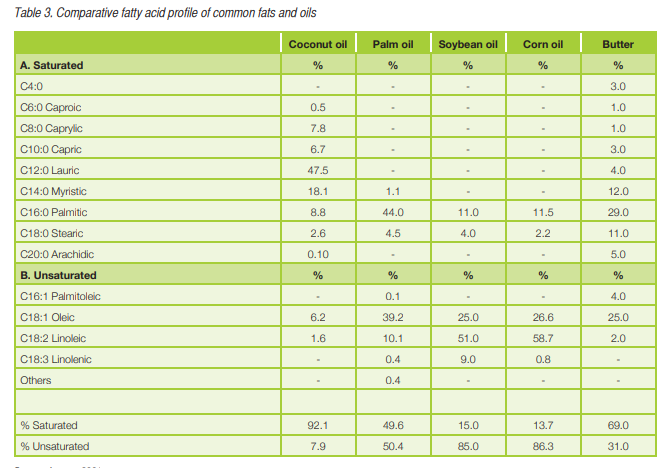
Coconut oil is very different from many common vegetable oils because it contains a much higher proportion of saturated fatty acids. A major component is lauric acid, supported by other saturated fatty acids such as myristic, palmitic, caprylic, and capric acid.
This composition gives coconut oil a very different technical profile compared to soybean oil, corn oil, or palm oil. In particular, its lower unsaturation helps explain why it behaves differently in shelf life, heat exposure, and formulation.
How coconut oil compares with other fats and oils
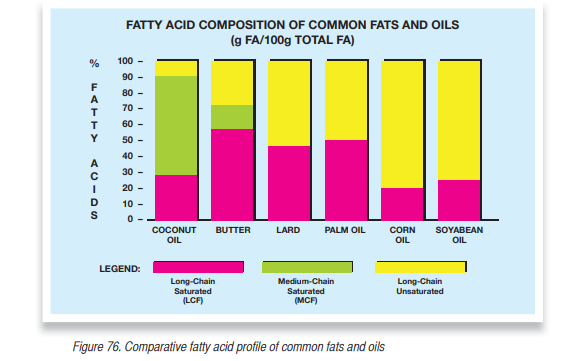
Coconut oil contains a much larger proportion of saturated fatty acids than many other common edible oils. In the chart and table below, you can see how it stands apart from oils such as soybean oil and corn oil, which are dominated more heavily by unsaturated fatty acids.
This difference is one of the main reasons coconut oil is often associated with better storage stability and different textural behavior.
Why this composition matters
The comparison above shows that coconut oil is far more saturated than oils such as soybean and corn oil. In practical terms, this means the oil is generally less vulnerable to rapid oxidation than oils rich in polyunsaturated fatty acids.
This is one of the major functional benefits of coconut oil. Instead of focusing only on broad lifestyle claims, buyers often evaluate coconut oil for:
- Storage stability
- Heat behavior
- Texture in finished products
- Suitability across multiple applications
More resistant to oxidation than highly unsaturated oils
Because coconut oil contains relatively low levels of polyunsaturated fatty acids, it is generally more stable than oils that are rich in linoleic or linolenic acid. This helps explain why it is used in products where oxidative stability matters.
In practical commercial terms, this can mean:
- Better shelf life potential when handled properly
- Lower risk of rapid rancidity compared with some other oils
- Useful performance in products that require fat stability
Of course, stability still depends on quality, moisture, peroxide level, packaging, storage temperature, and exposure to light and air.
Useful solid-liquid behavior
Coconut oil has a distinctive melting pattern. It is generally liquid at warmer room temperatures and becomes semi-solid or solid in cooler conditions. This makes it different from many oils that remain fully liquid across a wider temperature range.
This property can be useful in real applications because it gives coconut oil a body and texture that works well in:
- Balms and body care products
- Creamy or semi-solid food systems
- Soap and cosmetic formulations
- Oil blends where structure matters
Why the food industry uses coconut oil
In food applications, coconut oil is valued not only for its edible nature but also for how it behaves in formulation. Depending on the oil type and level of refinement, it can contribute neutrality or a recognizable coconut note, as well as a stable fat profile.
It is commonly used in:
- Cooking and frying applications
- Bakery and confectionery systems
- Processed food ingredients
- Premium edible oil products
Why coconut oil is widely used in cosmetic products
Coconut oil is also well known in personal care because it spreads easily, offers emollient character, and fits well in oil-based formulations. Depending on whether it is virgin or refined, it can bring either a more natural coconut profile or a more neutral base.
Common applications include:
- Hair oils and scalp products
- Skin oils and moisturizers
- Massage oils
- Soap and cleansing products
More than just a consumer oil
Coconut oil is not only a retail or consumer-facing ingredient. It also matters in industrial chemistry because its fatty acid composition makes it a valuable feedstock for oleochemical derivatives and other downstream uses.
This broader utility helps explain why coconut oil remains commercially important even beyond food and cosmetic markets.
Benefits can vary by coconut oil type
It is important to remember that the term “coconut oil” covers more than one product type. Virgin coconut oil and refined coconut oil do not offer exactly the same sensory experience or market positioning.
Virgin coconut oil is usually linked to fresh-kernel processing and a more natural profile, while refined coconut oil is typically more neutral and standardized. So when discussing benefits, it helps to specify which type of coconut oil is being considered.
Simple buyer summary
- High in saturated fatty acids
- Contains a strong lauric acid component
- Generally more stable than highly unsaturated oils
- Useful in food, personal care, and industrial applications
- Texture and sensory profile depend on oil type
The main benefit is functional versatility
The real strength of coconut oil is that it combines stability, distinctive fatty acid composition, useful texture, and wide application range. That makes it a practical oil for many industries, not just a popular ingredient in consumer marketing.
For buyers, formulators, and product developers, the most useful way to think about coconut oil benefits is through performance: how it stores, how it behaves, how it feels, and how it supports the final product.